
Seven governments have either introduced or are about to introduce the controversial agent law this spring. Rasmus Canbäck analyzes the role it plays in the Russian information war.
Av Rasmus Canbäck 28 maj, 2024
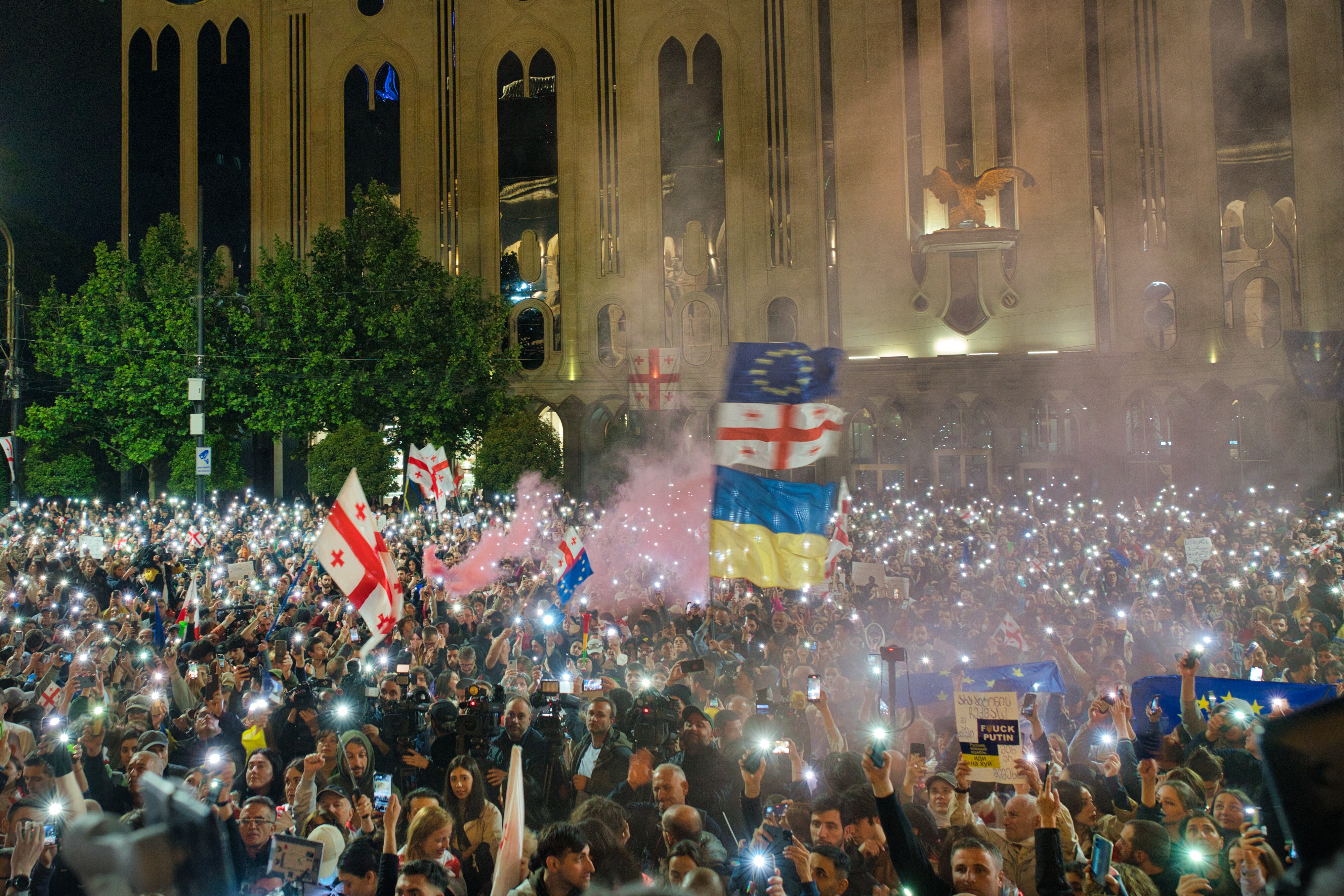
”No to the Russian law,” shout the demonstrators in front of the Georgian parliament. A speaker has just rhetorically asked the tens of thousands of listeners why they are there. The music starts blaring to raise the noise level even further, and there are as many EU flags as Georgian ones.
Despite American sanctions against government officials, despite EU diplomats’ threats of frozen EU negotiations, and despite the persistent public criticism of the law, it will come into force. It is seemingly incomprehensible to many why a country like Georgia, where 85 percent of the population believes that closer EU ties are the country’s most important geopolitical issue, would introduce the ”agent law.” This is what the demonstrators call the ”Russian law.”
The eyes of the world have primarily been focused on Georgia, where the popular opposition to the agent law is enormous. However, Georgia is not alone in introducing the law right now. Kyrgyzstan did so as recently as April, and Republika Srpska in Bosnia & Herzegovina had a similar parliamentarian process as Georgia earlier this year. It was, however, stopped the same evening as Georgia passed the law.
In May, Serbia’s socialist support party announced that they are working on a parliamentary motion regarding the law. In Turkey, state media reported that the government plans to introduce the law. Even in Hungary, an agent law, albeit in a milder form than the others, was adopted at the turn of the year. It is milder because the EU Court of Justice struck down the Hungarian government’s ambitions to introduce the law as early as 2021. The Hungarian government has also stated that they will work to ensure the agent law is introduced in more EU countries.
One such country is Slovakia, an EU member where the conservative government has announced that they want to copy the Hungarian version of the agent law.
In total, seven countries are introducing the ”foreign agents” law during the same period. All of these countries are what Freedom House terms ”Nations in Transit” – states at a crossroads between moving towards democracy or authoritarianism. These states are also considered to have either good relations with Russia or at least be under some degree of Russian influence.
It would be naive to believe that an almost identical law in all six countries is introduced simultaneously without having something to do with each other. Not least because the original agent law can be found in Russia from 2012. It has led to a systematic dismantling of Russian civil society.
In this analysis, I attempt to untangle the purpose of introducing the law, the rhetorical messages Russia packages around it, and which countries are next in line.

Disinformation About the Law
First and foremost, the most prominent disinformation about the agent law is that it is actually a copy of an American equivalent (FARA) from 1938. I won’t delve into a discussion on how the agent law differs from FARA, as that would be repeating the disinformation. Instead, I refer here to the analysis by political scientist and Caucasus expert Hans Gutbrod at the Friedrich Neumann Foundation, where he clarifies why the agent law has nothing to do with FARA.
What is important to note is that the false narrative claiming the agent law is inspired by the USA is prevalent in all the countries where it is being introduced. This is fueled by the governments themselves, as well as government-friendly and Russia-friendly media.
To give a few examples: In Georgia, one of the government’s main arguments is that the law is inspired by FARA. This is refuted by the USA, which has also imposed visa sanctions on those who have worked to introduce the law, and their families.
A foreign correspondent stationed in Georgia for the Russian state media TASS describes the law in Georgia as follows:
”It should be noted that alongside the Georgian bill, the authorities in parliament last year initiated an exact copy of the American law on foreign agents FARA, which has been in force since 1938.”
A similar description can be found in the Armenian version of the Russian state media Sputnik. Although Armenia currently has no plans to introduce the law, among some opposition groups, the narrative that it has valid points is prevalent.
”Opponents of this project call it a copy of the Russian law due to the introduction of the concept of a foreign agent in the legislation, even though the law on the registration of foreign agents has been in force for many years in the USA.”
The above quotes are examples from a reviewed material consisting of about thirty articles on the agent law from countries where Russian media are present (Armenia, Azerbaijan, Kazakhstan, Kyrgyzstan, Russia, and Turkey).
An important aspect is that the disinformation about the bill has a destabilizing purpose, which is reinforced by studies showing how Russia uses state media on social media to spread disinformation. By creating a debate about whether the bill is a copy of the American or the Russian law, distrust is sown among readers. Those who are skeptical of a geopolitical rapprochement with the Western world get more fuel for their fire.
It may seem paradoxical that Russia, on the one hand, wants to introduce the agent law in as many countries as possible and, on the other hand, spreads messages that it is a copy of FARA. Here, the narratives should be viewed as having separate purposes. The disinformation about FARA aims to foster distrust towards the West, while the introduction of the law aims to practically bring the states closer to Russia.
The latter can be seen in countries where the law has already come into force. In Kazakhstan, a register of ”foreign agents” was presented in 2023. In Uzbekistan, it was introduced in 2022, shortly after Russia’s invasion of Ukraine. Both countries have strong relations with Russia, and the view of civil society as a threat is shared by the countries’ leaders with Vladimir Putin.

Symbolic Alignment with Russia
”The law is a must,” stated Yilmaz Tunc, the Turkish Interior Minister, at the beginning of May. He emphasized that support for the law comes from ”judges, prosecutors, and ordinary citizens” who all believe that the agent law brings ”very relevant regulations.” Furthermore, he argued that foreign influences need to be curbed in the country.
It has proven easy for Russia to persuade somewhat friendly governments that the agent law is necessary. This is likely because the organizations that the agent law practically targets receive funds from European countries and the USA. Often, development aid comes with an emphasis on democratic principles.
The shift in aid over the past thirty years from governments to civil society organizations has created a dynamic where governments can view it as political. For example, only 23 percent of Swedish aid to Georgia goes to the public sector. The rest is distributed to multilateral organizations like the UN or EU and civil society. Sweden is the third largest donor to Georgia in the world.
In recipient countries, governments often see this funding as politically oppositional. These governments are either openly Russia-friendly (like Hungary), or at least isolationist (like Kyrgyzstan). Even though the introduction of the bill necessarily means a de facto alignment with Russia, it also involves a distancing from a Western alignment. Symbolically, it paves the way for closer cooperation with Russia, which similarly views Western funding as a threat.
This can be exemplified by the speech of Bidzina Ivanishvili, the founder of the Georgian ruling party, on April 27. It has come to be seen as a turning point in Georgia’s previously stated foreign policy aim of aligning with the West.
“The funding of NGOs, which they often begrudge us and count as aid, is used almost exclusively to strengthen the agents and bring them to power. Accordingly, these funds have nothing to do with aid, and, on the contrary, their only goal is to deprive Georgia of its state sovereignty.”
Countries Next in Line
While the agent law has been introduced in countries considered close to Russia, it also serves to create loyal groups in countries with significant political polarization. As mentioned, it is well covered in the Armenian opposition press, emphasizing that it is copied from the USA.
However, given the Armenian government’s recent deterioration of diplomatic relations with Russia, it is unlikely that the agent law will be introduced there soon. The function here is to use the agent law as leverage to appeal to isolationist groups, which is happening with some success. A common narrative is that Western funding partly strengthens the incumbent government, whose approval ratings are very low.
It is more likely that countries like North Macedonia or the Central African Republic are closer to introducing the law. After the recent election in North Macedonia, an anti-establishment government took power. One of the main reasons is considered to be that North Macedonia was forced to change its name to join NATO and open up for an EU application. Here, the Western world is blamed for forcing North Macedonia into what many perceive as humiliating concessions.
The Central African Republic has become Russia’s stronghold in Africa over the past decades. Russian mercenaries, including the Wagner Group, have been present in the country for a long time. Since 2021, university students in the country are required to study Russian.
It should be emphasized that there are currently no public plans in these countries to introduce the law. However, it has become clear that the agent law distinguishes a state’s alignment towards the West from isolationism and potential alignment towards Russia.
The demonstrations in Georgia, where hundreds of thousands take to the streets, are perhaps the clearest example of popular resistance against the formation of a new Iron Curtain.
Top Picture: Protesters outside of the Georgian Parliament. Photo by Rasmus Canbäck
Do you want to share your experiences or get in touch with the reporter? Send an email to rasmus@blankspot.se


