
The world is warning of another major war on the Red Sea. Headlines speak of escalation and new threats. But on Eritrea’s beaches, a remarkable calm prevails, and it is all dismissed as propaganda.
Av Blankspot 12 maj, 2026
This report was written in Eritrea in May 2026, before the latest developments. It reflects the situation and the views expressed at the time.
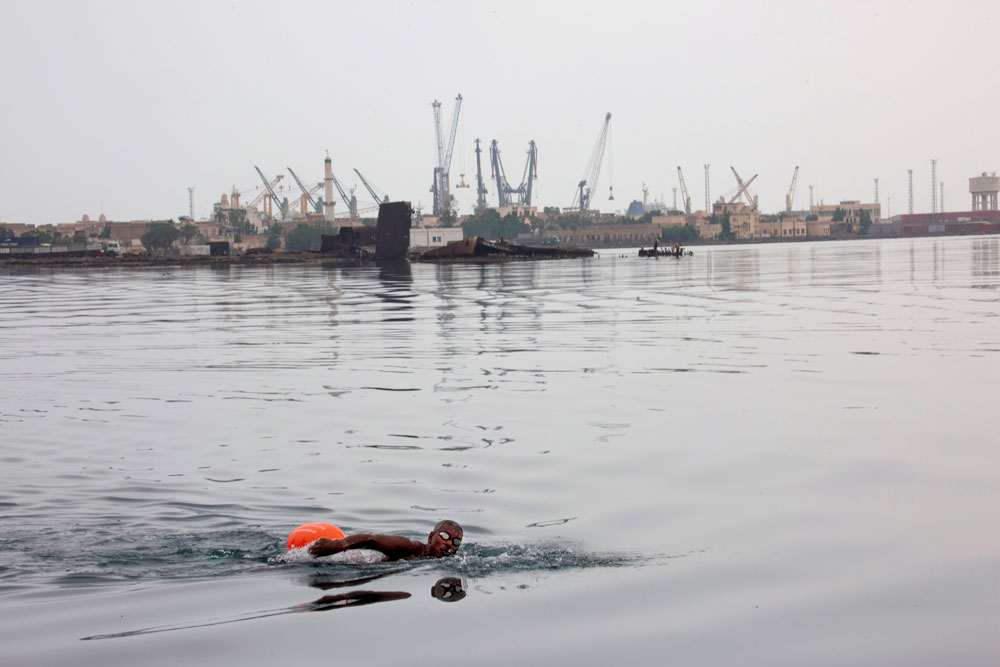
The Red Sea lies still, as though holding its breath. A swimming stroke breaks the silence, and the body of 70-year-old Swedish Eritrean Afeworki Woldai cuts through the mirror-like water.
The same waters he helped liberate 35 years ago.
Far behind him, in the port of Massawa, a grey-black container ship rocks silently. Offshore, ships lie at anchor, waiting.
After the Ethiopian army was driven out of the strategic port city, the Ethiopian air force responded by bombing it relentlessly for six days in February 1990. The Ottoman palace and the façades of the city’s buildings still bear witness to the bombs that fell two wars ago.
Ahead of him: the unbroken horizon of the Red Sea.
After an hour of swimming, Afeworki Woldai reaches the narrow spit of sand he was heading for and limps ashore, water dripping onto the warm sand.
“If war breaks out again, we will defend ourselves. But there are no winners in war. It is better to resolve the problems at the negotiating table,” says Afeworki Woldai, taking a sip of the water he boiled this morning.

Afeworki Woldai stands at the water’s edge in Massawa. Every morning, he swims in the calm waters—a routine that has become both a habit and a source of respite in a troubled region.
Woldai hates war more than anything else, and lives with daily pain that makes swimming easier than walking.
The reason is the shrapnel wound in his right leg, caused by a landmine he stepped on during the fighting in Barentu in 1978, one of many offensives in the war that liberated Eritrea in 1991.
Across much of the world, Ethiopian Prime Minister Abiy Ahmed’s feverish statements about his country’s existential need for a port on the Red Sea have generated alarming headlines such as “Risk of Ethiopia War Mounts” and “Red Sea Tension Rises”.
At the beginning of the year, the Ethiopian military staged a parade before a cheering crowd in Hawassa. Tanks rolled across the running tracks. Fighter jets roared overhead, and paratroopers marched in procession.
At the centre of the display, an enormous banner was unfurled, showing a soldier breaking open a door in front of a warship, alongside the words, in Amharic: “Whether they like it or not, we will not be shut out from the sea.”
Since then, the statements have ranged from describing access to the sea as an “existential issue” to presenting it as a matter of diversifying foreign trade.
More recently, the rhetoric has taken on a mystical nationalist tone, with talk of the country being “reborn” when “geography no longer limits the destiny of its 120 million inhabitants”.
But here, on the little spit of sand, the mood is anything but tense. Once Afeworki Woldai has settled into a blue plastic chair, he laughs at Ethiopia’s demands.
“This is my country. But of course, there is a possibility that Assab could become a free port in the future,” he says.

View of the hills around Ghinda, where some of the fiercest battles of the war of independence were fought.
Following the winding road from the coast up towards Asmara is like travelling from one country to another. The mountains rise like an impregnable fortress, and mist rolls down into the valleys. On either side: an explosion of green.
Your ears soon begin to pop, and the place names are familiar from history. In Ghinda, almost 2,500 metres above sea level, one of the last battles before the country’s liberation was fought. Around the same time, the football World Cup was being played in Italy.
In other words: the day before yesterday.
It took just seven years for the next war between the two countries to break out. This time, the Ethiopians were stopped at the Tsorona front and never reached the capital.
While we in Sweden watched Roger Pontare win the national Eurovision selection with “När vindarna viskar mitt namn”, 100,000 soldiers died defending Eritrea’s existence as a country.
Most Eritreans, in other words, are older than their own country. On arrival in the capital, Asmara, preparations are under way for the celebrations on 24 May marking 35 years as an independent nation.
Flags hang from building façades, and posters advertising the forthcoming celebrations cover shop windows.
Two posters are pinned to a noticeboard outside the Ministry of Foreign Affairs. One announces a meeting about the Red Sea; the other, a seminar on the Chinese strategist Sun Tzu’s two-thousand-year-old manual, The Art of War.
In the book, war is described as a matter of understanding rather than strength. Those who know both their enemy and themselves never risk defeat, Sun Tzu writes. Those who lack that insight are heading towards defeat, however large their army.
The book’s argument is that the decisive thing is not to win the battle, but to avoid it. The highest form of victory is to break an opponent’s will without firing a single bullet.

Night falls over Asmara, and the streets come alive. People move between bars and along pavements in a quiet nightlife—understated, but vibrant.
In his office, the country’s foreign minister, Osman Saleh, initially refuses to comment on the war rhetoric coming from the neighbouring country.
“It is better to remain silent. We have been silent. We have said nothing,” he says, explaining that this is because the whole idea is absurd.
Eritrea’s silence over the past year is thus a strategy rather than indifference.
Eritrea has no intention of helping to legitimise what it sees as unreasonable claims to its own coastline.
The borders were drawn during the colonial period, in a series of agreements in 1888, 1900 and 1905, lines later reaffirmed in the Algiers peace agreement in 2000. There, both Eritrea and Ethiopia agreed to accept the international boundary commission’s decision as final and binding, the precise wording used in the agreement.
But despite the boundary commission’s decision, Abiy Ahmed is demanding Eritrea’s port city of Assab. He talks about territorial waters. About the coast. About building an Ethiopian navy there. What is your response?
Osman Saleh listens calmly to the question, but still does not want to answer, for fear of fuelling the conflict.
“Eritrea has no case to pursue here,” he eventually says. “But if we are attacked, we will defend ourselves.”
It sounds strange: Abiy Ahmed is loudly demanding Assab and access to the sea, yet Eritrea says it does not even have a “case”?
Foreign Minister Osman Saleh explains that, of course, they follow everything being said in the neighbouring country, and describes a two-year Ethiopian media mobilisation. He says Abiy Ahmed has not merely championed the issue himself, but has built an entire ecosystem of voices, cultural figures and academics, tasked with legitimising the idea of Ethiopian access to the Eritrean coast.
“They have been preparing the propaganda for two years,” he says, insisting that for a long time it was all words, with no concrete signs on the ground. But now Ethiopian forces have been moved towards Eritrea’s border.

For Eritrean Foreign Minister Osman Saleh, access to the Red Sea is once again at the centre of both diplomacy and geopolitical tensions in the region.
A war could trigger a domino effect in which, in theory, Egypt, Saudi Arabia, Somalia and Sudan might rally behind Eritrea, while Ethiopia could receive support from Sudan’s RSF and the United Arab Emirates, as well as weapons from Israel and Azerbaijan.
In the background are also Russia, the United States, Turkey and India, all with interests in the Red Sea—the main artery of the global economy.
The danger of a wider war is therefore real, even if an attack has yet to come. The US war against Iran may have temporarily slowed the plans, as Ethiopia’s ally, the United Arab Emirates, also has its hands full.
Asked whether he really believes Abiy Ahmed will launch an attack, the foreign minister instead lists Ethiopia’s internal problems: the wars and conflicts in Tigray, Amhara, Oromia, the Somali areas, Afar, Benishangul-Gumuz and Gambela.
According to Eritrea’s foreign minister, resistance to Abiy has grown stronger in several parts of the country.
Recently, he says, the world has seen rebels in the Amhara region take large numbers of prisoners of war, soldiers desert, and Abiy’s newly trained army units fail to hold their lines.
All this makes a full-scale attack on Eritrea appear militarily difficult—but not impossible.
“If that is the situation, will he be able to attack Eritrea? I question that. But he may force it through anyway. He may push things in that direction.”
A new factor in this possible future war is that the era in which the former ruling party, the TPLF, and Eritrea were bitter enemies is now over.
“You cannot remain enemies forever. Sometimes you fight. Sometimes you become friends. If Abiy Ahmed has become an enemy of both Tigray and Eritrea, then it is natural that both are ready to defend themselves,” Saleh replies pragmatically.
But asked whether this means Eritrea supports groups inside Ethiopia, as it has often been accused of doing, his answer is no.
“We do not currently support any Ethiopian movement. Ethiopia must solve its own problems. We will not solve them,” says Saleh.
Although Ethiopia has positioned forces close to the border, Osman Saleh rejects the suggestion that Eritrea has done the same.
“Our forces are already there,” he says. “In the Badme area, in the Assab area. To ensure our security. We are not deploying them now. They are there. They are ready for anything. They have always been there. Since liberation, we have always lived either at war or in a situation of ‘no war, no peace’.”
Osman Saleh says the threat from Ethiopia since 1998 means there is no need for any special mobilisation.
“Our people are already prepared. They know. They know who we are and who they are.”
Rather than worrying about a war that has yet to break out, Osman Saleh says he is more concerned about the war now being waged against Iran and the broader geopolitical shift it represents.
“A paradigm shift is under way. The rules-based world order is beginning to fracture,” he says, describing a world entering a new, more unpredictable phase in which international law has lost its significance.
The institutions that were meant to hold back chaos can no longer do so.
“If there is no longer a rules-based order, what is left to hold us together?”
When Dag Hammarskjöld’s old formulation is mentioned, that the United Nations was created not to take humanity to heaven, but to save it from hell, Saleh responds with a bleak vision of the future:
“Now it seems that the UN can no longer save us from hell.”

As tensions around the Red Sea change the way major powers view the region, new signals are coming from Washington. On 5 May 2026, Reuters reports that the United States is now set to lift the sanctions imposed on Eritrea during the Tigray war in 2021.
The announcement is linked to Eritrea’s strategic location, with 7,000 kilometres of coastline along the Red Sea, opposite Saudi Arabia and Yemen, at a time when trade routes through both the Strait of Hormuz and the Red Sea have acquired greater geopolitical importance.
For Eritrea, which has long lived under sanctions, this would signal that the international community’s focus is shifting from human rights to security policy.
“Easing sanctions now—without accountability for grave abuses—would signal tolerance for future abuses,” says Human Rights Watch’s Laetitia Bader in a statement after news of the US plans became public.
The organisation also points out that, according to HRW, Eritrean forces committed massacres, sexual violence and looting during the war in Ethiopia’s Tigray region. It warns that lifting sanctions without clear conditions risks signalling that grave crimes can be committed without consequences.
“Transactional diplomacy that ignores human rights abuses risks cementing decades of impunity,” the organisation’s expert continues. She describes Eritrea as one of the world’s most repressive countries, with a national service system that, according to the organisation, amounts to forced labour, as well as mass arrests of critics, religious leaders and journalists without due process.

In Asmara’s cafés and streets, many dismiss the threat of war as empty rhetoric. “It is just talk. Propaganda,” says Fesahaie Habtemariam—a view shared by several others: concern is there, but few believe war will actually break out.
Outside Albergo Italia, one of Asmara’s many iconic hotels, people move between cafés in the morning light. A quiet urban life, far removed from the war headlines.
In the hotel courtyard, manager Tecle Weldeslase is writing a post that he will shortly go out to publish on his Facebook page. His own hotel has no internet connection.
“I am writing to congratulate the Iranian people, who, despite the attacks, stand firm, defend their sovereignty and refuse to give in.”
Tecle Kesete believes the world is currently governed by a lawless order in which “might makes right”. Having grown up in Mendefera, he remembers aircraft bombing at night and his family being forced to flee when Ethiopia’s Derg regime launched an offensive in the late 1970s.
Later, after independence, came the next war: the border war with Ethiopia in 1998. Then he faced a choice. He could leave the country. His name was on a list of people who could be evacuated with the Americans.
“I chose to stay and defend my country,” he says.
It is with that experience behind him that he looks at today’s headlines about another war.
“We are not worried. We are always ready for whatever comes. We did not learn about war at college. That does not mean a shot cannot be fired. But we will not fire the first one.”
The contrast between the media discussion of another major war and the mood in the country is as sharp as the light.
Everywhere in Asmara, there is an elusive sense of normality. The traffic lights, long switched off, are now working. And although the city remains sleepier than other capitals on the continent, there are more taxis and more customers in its many cafés and restaurants than there were a decade ago.
At Obhar Café in central Asmara, Norwegian Eritrean Fesahaie Habtemariam sits looking out at the statue of Alexander Pushkin, the Russian poet with an Eritrean grandfather.
“It is just talk. Propaganda,” says Kebreab, explaining that all Eritreans are following developments closely, but few believe Ethiopia will actually try to take Assab.
At the same time, he points to what is happening on the other side of the border: internal conflicts, economic pressure, and a country where he believes the situation is worse than in 1984, during the great famine.
“No one in Asmara is afraid. Only a madman would start a war with that hand of cards.”
A short walk from the statue is the street that in 1952 was called Haile Selassie Avenue. When the emperor was overthrown in 1974, it was renamed National Avenue. When Mengistu’s regime, too, fell, it acquired its current name: Harnet Avenue—Independence Avenue.
Most people here cross against the red light, but Swedish Eritrean Mehrat Mehari, who grew up in Stockholm, stands waiting for green as she tries to put into words what everyone is discussing.
“I have heard that he wants Assab… but I do not understand why. It is Eritrea’s port city. The Red Sea means everything,” she says. Having experienced war, she hopes it never breaks out.
“I just hope there will be peace. Peace is best,” says Mehrat Mehari, crossing the street as the traffic lights change.

Eritrea’s information minister, Yemane Gebremeskel, in his office in Asmara. In his statements, he dismisses Ethiopia’s claims as a “charade”—and chooses not to give them further space in the debate.
Although Eritrea has sidestepped most of Ethiopia’s diplomatic and media pronouncements over the past year, there is one minister who communicates. Through his account on X, the country’s information minister, Yemame Ghebremeskel, provides the outside world with analysis and reflections from his office on a hill overlooking Asmara.
But he, too, is reluctant to discuss the issue with foreign journalists. The reason is that he does not want to lend Ethiopia’s claims any legitimacy either.
For him, this is not a “controversy in which two sides weigh their arguments against each other”.
On the contrary, he describes Ethiopia’s position as unlawful and dangerous.
“Our position has been that this policy is so provocative and reprehensible that we do not want to fall into the same trap,” he says. “That is why we do not want to respond in detail in the media. It would mean elevating something so base into a subject for discussion.”

The sea around which everything revolves. Here, at Eritrea’s gateway to the Red Sea, trade and great-power politics meet. One theory is that Ethiopia’s prime minister, under pressure at home, is playing the nationalist card to broaden public support ahead of the forthcoming election in June.
The entire Ethiopian narrative, he argues, lacks both a legal and a practical basis, and he considers it absurd that the outside world pays any attention to these pronouncements. Journalists writing about a war that does not yet exist should be reporting on the civil wars in Ethiopia that are actually under way.
And why, he asks, should European countries such as France cooperate in building an Ethiopian navy when Ethiopia has no territorial waters of its own?
The very fact that such discussions can take place, ”even symbolically”, he describes as theatre.
“It is a charade,” he says. “I do not understand the charade. If someone comes to my house and says he intends to throw me out, that is not a matter for judicial review. It is not a matter for debate. It is not a question where you can weigh different perspectives against each other or look for compromises. There is no middle ground.”
That is why, he says, official statements have been kept very brief and to the point: Eritrea does not accept the agenda and has no intention of playing along.
“There is no confusion among our people. We know our history. We know the price we have paid for our national and human dignity.”
Asked whether Ethiopia would really try to take Assab, or whether it is all just rhetoric, he offers no simple answer.
“The political will is there. The material preparations are there. So you cannot rule it out,” he says. “But there is also a difference between desire and reality.”
No one, as he puts it, has a crystal ball.
“Wars are often born of miscalculations. Is it likely? Will it happen tomorrow? In two years? Nobody knows.”

At the very tip of the sand spit on Green Island, land meets sea. Here, war feels far away.
Back on the coast, the sun has reached its zenith. Afeworki Woldai gets up from the blue plastic chair and packs away his solar panel, tent and water bottles. Every winter morning in Stockholm, he has stood outside Tensta swimming pool at 6.30 a.m., dreaming of this sea.
If you stop moving, he says, you end up sitting still.
“That is just a dream. This is Eritrea, not Ethiopia. They can try,” says Afeworki, limping away along the shore.
The leg injured by a landmine in 1978 leaves distinct footprints in the wet sand.
“There will be no war. It is just bluster.”
Reporting from Eritrea: Martin Schibbye and Donald Boström.
Blankspot is an independent Swedish media outlet founded in 2015, covering underreported stories from around the world through in-depth, on-the-ground journalism. Read more lon-form journalism from Eritrea here.
Av Blankspot
Hjälp oss skriva mer om Eritrea!
Stöd oss så att vi kan fortsätta att rapportera från Afrikas horn. Swisha ditt stöd till 123 554 35 41 eller donera.


