
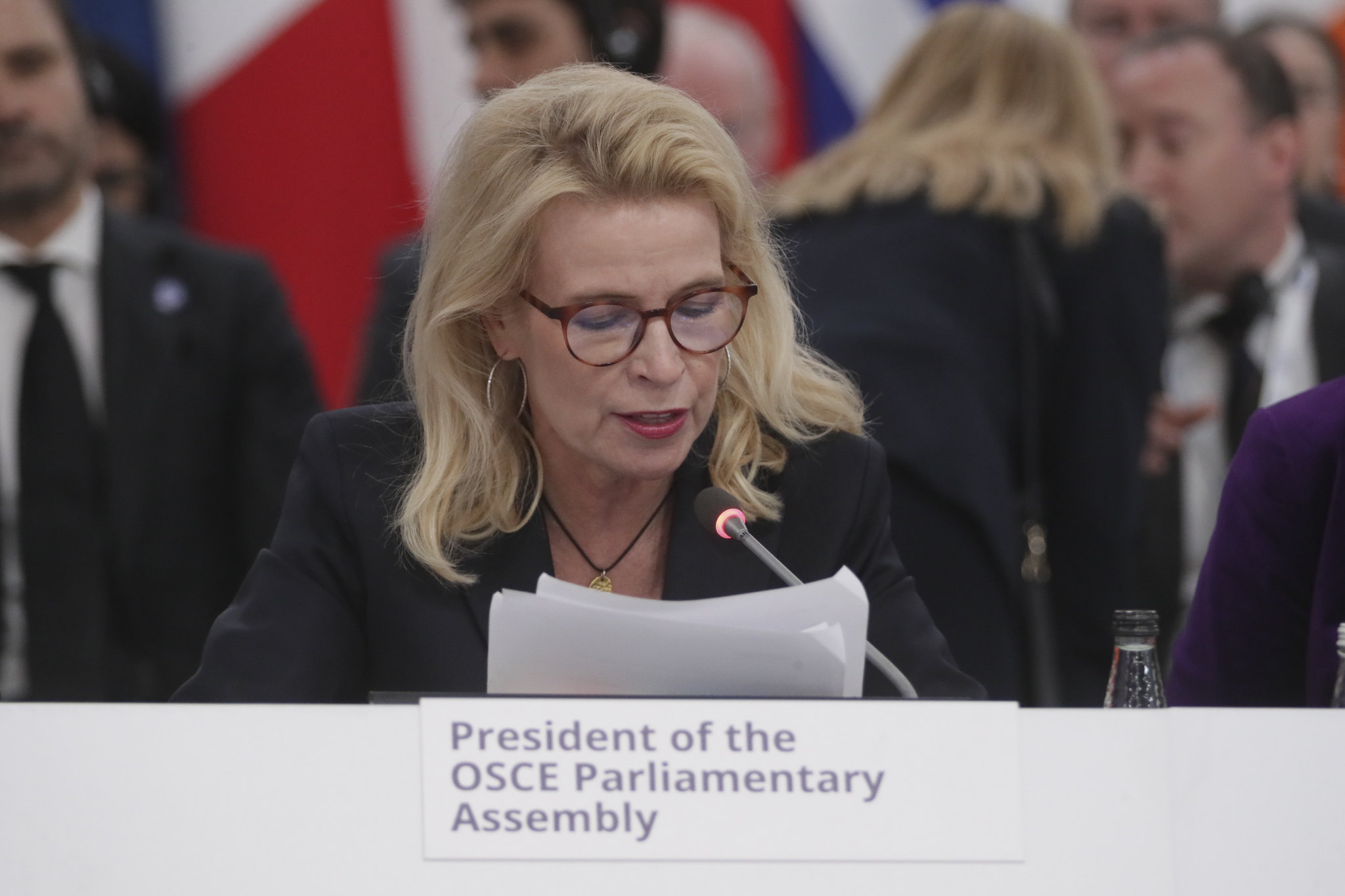
The controversies surrounding the Georgian election continued over the weekend when Finnish MP Pia Kauma (National Coalition Party) canceled a trip to Georgia following a storm of criticism.
Av Rasmus Canbäck 9 januari, 2025
In her role as Chair of the OSCE Parliamentary Assembly (OSCE PA), Finnish MP Pia Kauma, together with Vice Chair Luis Graca (Social Democrat, Portugal), was set to travel to Georgia. The purpose of the visit was to follow up on the OSCE/ODIHR’s final election observations from October 26 and to assess how the Georgian government plans to implement the report’s recommendations.
The interpretations of the election observation report have been a point of contention, as previously reported by Blankspot. While the Georgian opposition, supported by several EU member states, argues that the report highlights numerous irregularities that collectively call the election’s legitimacy into question, the government contends that the report confirms the election was conducted properly.
Experts, such as the German political scientist Hans Gutbrod, who has worked in Georgia for decades, argue that the election was characterized by systematic manipulation by the government.
Since the election, the EU-aligned opposition has boycotted parliamentary proceedings, claiming the government should be considered illegitimate. Meanwhile, the seemingly pro-Russian government has struggled to find allies in the West. In December, the EU discussed sanctions, though these were blocked by Hungary and Slovakia, while the United States has imposed economic sanctions on the country’s leadership.
The final consolidation of Georgian Dream’s power occurred when opposition-aligned President Salomé Zourabishvili’s term ended on December 29. She was replaced by the government’s nominee, Mikheil Kavelashvili, a former footballer criticized by the opposition for lacking qualifications. Zourabishvili has announced that she will continue acting as the country’s president and is seeking international recognition.
In response, the Georgian government has hinted it might consider arresting Zurabishvili.
Against this backdrop, the planned visit by the OSCE PA leadership came at a sensitive time. Meeting with government representatives could, according to the opposition, normalize the government and indirectly validate the election results as legitimate in the eyes of an international institution. Former Prime Minister and now opposition leader Giorgi Gakharia argued that the Georgian government would exploit the visit to assert just that.
The announcement of Pia Kauma and Luis Graca’s plans to visit the country sparked internal criticism within several EU member-state delegations in the OSCE PA. Internal communications, reviewed by Blankspot but withheld to protect sources, reveal discontent among multiple EU delegations. This criticism has been corroborated by several independent sources within the OSCE PA.
Pia Kauma, a Finnish MP from Finland’s ruling party, also lacks the support of Finland’s Ministry for Foreign Affairs. In a statement to Blankspot via its press office, the ministry noted that Pia Kauma is aware of Finland’s position toward Georgia.
”The Finnish Parliament and PA President Kauma are well-informed about the Finnish Government position [regarding Georgia].”
In its written response, the press office refers to Finland’s participation in the Nordic-Baltic format (NB8), which has a unified stance on Georgia, and notably refers to Zourabishvili as ”president.”
”The NB8 countries have recently released a statement to urge the Georgian authorities to take immediate steps to implement the OSCE electoral recommendations and condemning violence and intimidation against peaceful protesters, politicians and media representatives as well as the threats directed towards President Zourabishvili”.

The decision to travel to Georgia was also met with criticism from the United States. Joe Wilson, the U.S. representative to the OSCE PA, sent a letter to Pia Kauma urging her not to proceed with the trip.
This was followed by a similar appeal from the Georgian opposition, which in turn sparked a storm of criticism against Pia Kauma on Georgian social media.
Ultimately, Pia Kauma announced that the trip to Georgia would be postponed. In an internal letter to OSCE PA representatives, obtained by Blankspot, she explained that it was not currently possible to hold discussions with all parties in Georgia.
“[…] tangible progress would require broad-based discussions, which are not possible at this stage.”
In the same letter, she mentioned that she had engaged in discussions with Georgia’s Prime Minister Irakli Kobakhidze. According to Kauma, he expressed a “willingness” to implement the OSCE/ODIHR recommendations and to “revisit and amend the law on transparency of foreign influence”—the so-called “foreign agent law.”

What Irakli Kobakhidze meant by being open to ”revisit and amend” the law has been explained in greater detail. In an interview with Blankspot on December 16 in Tbilisi, the Chair of the Georgian Parliament’s EU Affairs Committee, Levan Mekhashvili, elaborated that the government might amend the law if the European Court of Human Rights deems it necessary.
“[The law] has been challenged by Georgia’s Constitutional Court. It is now also being challenged by the European Court of Human Rights. Let’s wait to hear what the Strasbourg court has to say, and we will comply with it. If the court finds that it violates any aspect of the European Convention, that’s perfectly fine with us. In that case, we will amend it if necessary,” Levan Mekhashvili told Blankspot.

The controversial “foreign agent law” has been criticized for being modeled on Russian legislation. During the spring, the law was in the process of being introduced in five countries (Georgia, Kyrgyzstan, Slovakia, Hungary, and Turkey), all of which maintain varying degrees of relations with Russia. According to the Georgian government, the law aims to increase transparency for organizations receiving foreign funding. In his interview with Blankspot, Levan Mekhashvili argued that the line between political parties and civil society organizations has become blurred, making the law necessary.
Critics, however, argue that its true purpose is to restrict a free civil society. Both the European Commission and the OSCE have voiced strong criticism of the law. In Russia, a similar law introduced in 2012 has systematically dismantled civil society.
In the spring, EU member states decided to halt Georgia’s EU accession process as a result of the law’s introduction—just six months after Georgia had been granted EU candidate status.
In November, the Georgian government announced it was shelving its EU ambitions until 2028. This decision provoked strong reactions from opposition groups, who have since held daily protests, which have occasionally been met with police violence.
Pia Kauma’s letter to the OSCE PA sparked additional controversy regarding her stance on Georgia. On social media, opposition activists criticized her for welcoming the government’s proposal to potentially amend the law, rather than rejecting it outright. It was perceived as a shift in rhetorics from the West.
Blankspot reached out to Pia Kauma for comment. She referred to an interview she gave to the Georgian outlet Civil.ge for clarification. In that interview, she reiterated that the purpose of her trip was to engage in discussions with all sides in the country. She also stated that her decision to postpone the trip was not due to the criticism she faced. Instead, she emphasized that the opposition’s unwillingness to meet with her made it impossible to fulfill the trip’s objective of engaging with all parties.

To Blankspot, she elaborated further. When asked whether she believed the trip to Georgia risked conflicting with Finnish government policy toward Georgia, she responded that she did not believe it did.
”No, I don’t. I have very good communication with the Finnish government. It is normal practice for the OSCE PA to pay a trip to the country after the final report of the election observation mission has been issued. This time ODIHR chose to accelerate the delivery of this report, as it was known that there are severe tensions and demonstrations still taking place in Georgia,” Pia Kauma wrote in a written response.
We further asked whether she believes the so-called foreign agent law should be amended or entirely repealed.
”The best thing of course would be to demand annulment of it all together. If that is not possible, then amending or revisiting the law would be the second best option. It may be advisable to bear in mind that there are similar legislations related to foreign influence still in force in for example France, the US and Canada. Amending or revisiting the law according to these countries might be a good alternative,” she wrote.
Finally, she added that she understands the concerns expressed by colleagues from the NB8 format. She emphasized that she looks forward to exchanging views with them during the OSCE PA meeting in February or earlier if necessary.
During the spring protests, Georgian and Russian media frequently compared the ”foreign agent law” to legislation with a similar name in the United States. This comparison was dismissed by human rights lawyers, who pointed out its similarities to the Russian law of the same name.
The Georgian government responded by claiming that ”foreign influence” was behind the postponed visit. Prime Minister Irakli Kobakhidze further accused “liberal fascists” of orchestrating an influence operation.
”In the past, we had to talk with Mrs. Pia Kauma about how liberal fascism works, for example, in Georgia, and in reality, she herself felt the effects of liberal fascism the most. I think Mrs. Kauma saw that this is quite a large-scale coordinated effort. This is not a Georgian phenomenon, it is an internationally coordinated phenomenon,” he said.
The date for the trip to Georgia has not yet been decided.
Top image: Press photo of Pia Kauma from the OSCE PA website.
Would you like to tip the reporter or share your own experiences? Email rasmus@blankspot.se.


