
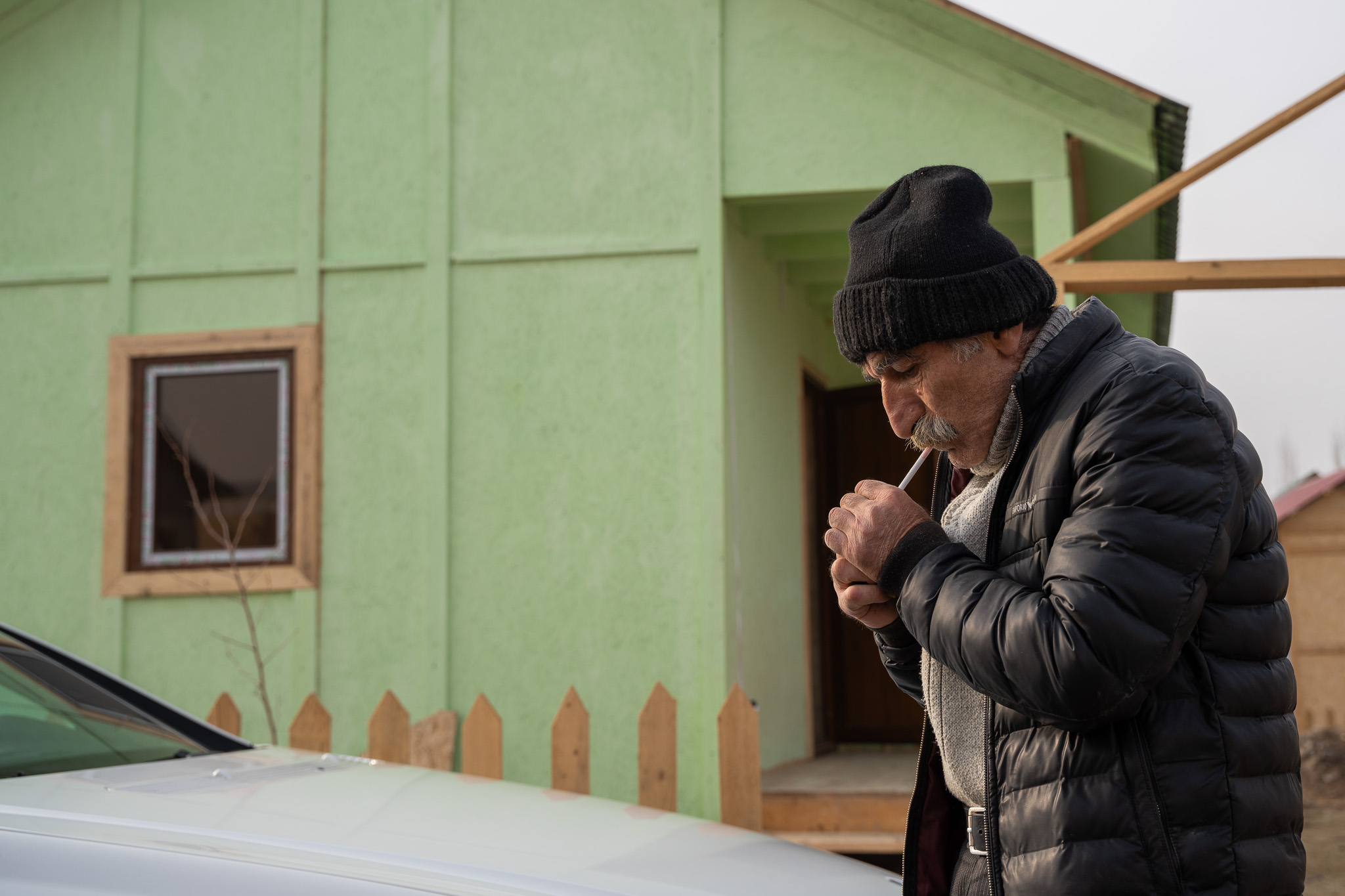
In the eco-village of Arin Berd outside Yerevan, refugees from Nagorno-Karabakh are trying to build a new life. Amid the winter cold, they struggle with the loss of their home, all while Armenia's support dwindles and the future remains uncertain.
Av Rasmus Canbäck 20 februari, 2025
The hammering sound stops as a man calls out instructions to another. A little further down the street, a carpenter arranges planks to be cut. Above him, an electrician stands on a ladder, pulling cables between newly erected poles. They all wear warm hats, and their breath turns to mist in the cold air.
Winter has taken hold of the small “eco-village” Arin Berd on the outskirts of Yerevan. But the work to complete the new village must go on.
“We just moved here. It was a bit cheaper for us… well, because we’re from Artsakh,” says Armen Harutyunyan, using the Armenian name for Nagorno-Karabakh.


His house is one of the few that is almost finished. It is still more of a shell than a completed house. The plywood panels that make up the walls are painted green on the outside to give a sense of home. The neighbor’s house is pink, and further down the road, there are houses in all sorts of colors.
”Since we came to Armenia from Artsakh, we’ve been searching for a place to live. Now we’re trying this. If it doesn’t work out, we can get our deposit back for the house,” says Armen.
He explains that the idea is for the village to house mainly families from Nagorno-Karabakh. Those who move there are offered subsidized housing, which at least on paper seems attractive. Over time, the plan, according to the constructor, is to open shops, a small sports facility, and possibly a school in the area.
The issue of housing for the more than one hundred thousand refugees has been urgent since the mass exodus in September 2023. This was after Azerbaijan launched a swift offensive against the Armenian-populated Nagorno-Karabakh, forcing the entire Armenian population to flee. Only a handful of Armenians remain.


In Armenia, the status of refugees has been a hot topic in domestic politics. The debate has covered everything from the right to obtain Armenian passports to the amount of refugee aid provided. Many refugees also feel they are being discriminated against and accuse the Armenian government of exacerbating the issue.
For example, the parliament’s spokesperson, Alen Simonyan, was criticized for marginalizing refugees after stating that they should have stayed in Nagorno-Karabakh. The criticism has been followed by reports indicating that such incidents are not isolated.
At the same time, the government decided in December to reduce support for refugees. Armenia’s Prime Minister Nikol Pashinyan defended the decisions.
”We need to create conditions where people can support their families through their own work,” said Nikol Pashinyan.


The subsidized housing in Arin Berd shows that some initiatives are underway to support refugees. Many of them are funded from abroad, but the aid allocated to relief projects is relatively sparse compared to other refugee crises. The EU has since 2023 sent around 18 million euros to support the Armenian government in refugee assistance, and other countries, such as Sweden, are individually running various development projects aimed to improve the conditions for refugees.
In this context, Arin Berd has become one of the flagship projects. Its social media highlights that the housing is of “high quality” and “eco-friendly.” However, this somewhat contrasts with the reality on the ground.
Just a few hundred meters away, on the other side of the hill, Yerevan’s garbage dump sprawls, and across the road from the village is an industrial area. The dump has gained a reputation for being mismanaged, with trash being burned and accusations of a lack of recycling. This has contributed to the worsening air quality in Yerevan.

”We haven’t really noticed the landfill much so far. It’s over there, but the houses here are protected by earth embankments,” says Armen Harutyunyan.
His son Tatul chimes in, saying that the bigger problem is how the houses have been built.
”They’ve been built quickly and sloppily,” he says, walking to the bathroom to show what it looks like.
He points out that the floor isn’t sloped enough for the water to drain properly into the sewage.
”Yeah, you can see for yourself that it’s not very good. They built it quickly. But what are we supposed to do? We’ve moved several times since we came to Armenia, and we just have to try to find a place to call home,” he says.

The situation is hardly unique. Many families, since arriving in Armenia, have been forced to pay high rents on the largely unregulated Armenian rental market. Even before the mass exodus, rents, especially in Yerevan, had risen sharply. This was a result of many Russians relocating to Armenia after Russia’s invasion of Ukraine in 2022. A similar situation exists in several former Soviet states, which typically have liberal visa laws for Russian citizens.
With the exodus, unemployment has also become widespread among Armenians from Nagorno-Karabakh. Statistics vary, but they suggest that tens of thousands may have moved to Russia to find work. Many of them have also returned.

Living in a situation where neither work nor stable housing is available has led many to feel a sense of rootlessness in Armenia. An infected conflict has also emerged between the former leadership of Nagorno-Karabakh and the Armenian government. This can be partly explained by the former leadership’s somewhat oppositional stance on the government’s policies.
In Arin Berd, the Harutyunyan family is trying to settle, even though they miss the mountains of Nagorno-Karabakh.
”We had to leave a car behind. But that was probably not the worst part. Not a day goes by without me thinking about my home. I don’t know how to stop thinking about it,” says Armen.
His son Tatul agrees.
”Sometimes I think it was a mistake to leave Artsakh. I know there was no other choice, but it hurts so much to think about it. I hope things will get better here,” he says.
Top image: Armen Harutyunyan lights a cigarette in front of his new house. Photo by Rasmus Canbäck
Do you want to tip the reporter or share your own experiences? Email rasmus@blankspot.se


